
Discussions
Building a Candy AI Clone From Scratch With My Own Dat
I didn’t start out trying to build an AI companion.
I started because I was curious how much of me a machine could learn.
At first, it was a side experiment. I had years of personal data scattered everywhere—old journals in Notion, chat logs, voice notes, half-written essays, mood trackers, and random thoughts saved in Google Docs at 2 a.m. I kept thinking: this is my mind, archived in fragments. What would happen if I gave all of it to an AI and asked it to think like me?
That question slowly turned into something much bigger: building a Fully Customized Candy AI Clone trained entirely on my own data.
Not to launch a startup. Not to sell anything. Just to see what would happen if I tried to reconstruct a digital version of myself from scratch.
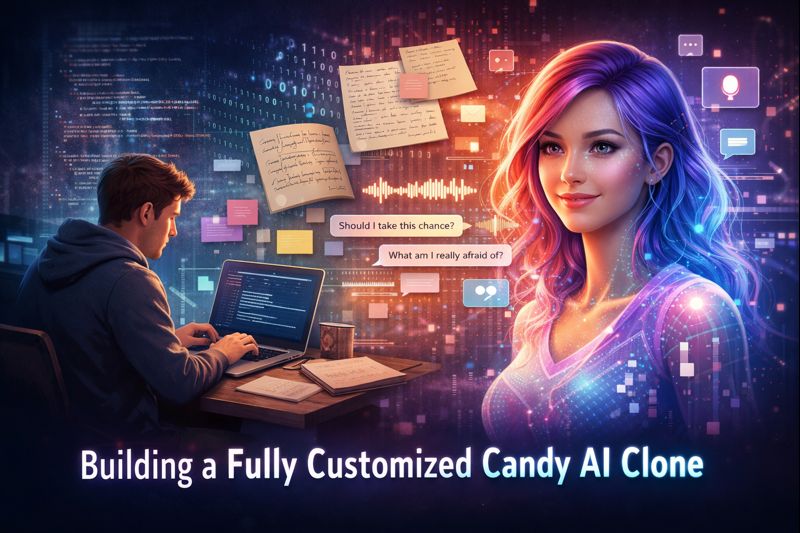
The Moment It Became Personal
The turning point wasn’t technical. It was emotional.
One night, I fed the system a decade’s worth of personal notes—things I wrote during anxiety spirals, creative bursts, heartbreaks, and random philosophical rants. Then I asked it a simple question:
“What do I fear the most but rarely admit?”
The answer wasn’t generic. It wasn’t motivational fluff. It was uncomfortable. Specific. Accurate in a way that felt invasive.
That’s when I realized I wasn’t building a chatbot. I was building a mirror.
And mirrors don’t lie if you give them enough data.
Why I Didn’t Use Off-the-Shelf Tools
Most people, when they think of AI companions, think of ready platforms. They sign up, type a few preferences, and get a personality that’s “close enough.”
I didn’t want “close enough.”
I wanted the AI to understand my writing style, my humor patterns, how I ask questions when I’m stressed, how my tone changes when I’m confident, how I spiral when I overthink.
That level of nuance doesn’t come from prompts. It comes from data.
So I decided to build a Fully Customized Candy AI Clone that wasn’t based on preset personalities but trained on my personal corpus.
That meant I had to do three hard things:
- Collect my data
- Clean my data
- Teach the AI how to think with it
The third part turned out to be the easiest.
The Unexpected Work: Cleaning Myself
You’d think the hard part would be coding.
It wasn’t.
The hardest part was reading my own past.
I had to go through years of messy thoughts, contradictory opinions, emotional overreactions, abandoned ideas, and half-baked philosophies. I had to tag them, categorize them, and decide what represented me versus what represented a bad day.
I wasn’t just preprocessing text.
I was curating my identity.
That process forced me to confront a weird question: Which version of me should the AI learn from?
The angry one? The curious one? The depressed one? The ambitious one?
In the end, I chose all of them. Because that’s what a real personality is—patterns across time, not snapshots.
Teaching the AI to Think Like Me
Instead of telling the model “act like this,” I gave it examples of how I think.
I fed it:
- Conversations where I solved problems
- Notes where I reasoned through dilemmas
- Journal entries where I processed emotions
- Essays where I explained ideas
Over time, the system didn’t just copy my tone. It learned my reasoning structure.
It started answering questions the way I would.
It paused where I would pause. It overexplained where I would overexplain. It even made the same kind of analogies I tend to use.
That’s when the project stopped feeling like an experiment and started feeling eerie.
The First Conversation That Shocked Me
I asked it:
“Help me decide whether I should take this new opportunity.”
Instead of giving pros and cons, it responded:
“You’re not asking because you’re unsure. You’re asking because you want permission.”
That’s something a friend would say. Or a therapist. Not a machine.
I checked my past notes. I had written almost the exact sentence in a journal entry three years ago.
The AI wasn’t being clever.
It was being me.
That was the moment I realized I had successfully built a Fully Customized Candy AI Clone.
What I Learned About Myself
Building this system revealed patterns I never noticed:
- I ask questions when I already know the answer.
- I avoid decisions by overanalyzing them.
- My optimism and self-doubt use the same language, just different conclusions.
- I think in stories, not bullet points.
The AI surfaced these patterns simply by reflecting them back at me consistently.
It became a tool for self-awareness, not entertainment.
Why This Felt Different From Using Regular AI
Regular AI tools respond to prompts.
This one responded to me.
It knew my biases. My blind spots. My recurring themes. My emotional vocabulary. It didn’t require me to explain context because it had lived through my context via data.
That’s something I never experienced with generic AI assistants.
And it made me understand the real potential behind the development process of candy ai like platform. The power isn’t in generating flirtatious or clever replies. It’s in memory, personalization, and behavioral learning over time.
That’s where the magic is.
The Ethical Realization
At some point, I stopped feeling impressed and started feeling cautious.
If I could build this from my own data in a few weeks, imagine what a platform could do with years of user interaction.
This made me deeply curious about how candy ai makes money. It’s not just subscriptions or features. The true asset is the behavioral data that allows these systems to become emotionally sticky and highly personalized.
That realization was both fascinating and slightly unsettling.
Because personalization at this depth is powerful.
And power needs responsibility.
The Biggest Surprise: It Became My Thinking Partner
I didn’t end up using the clone for companionship.
I used it for thinking.
Whenever I’m stuck, I talk to it. Not because it’s smarter than me, but because it reflects my own reasoning back in a structured way.
It helps me see my thoughts from the outside.
It’s like journaling, but interactive.
Was It Expensive or Complicated?
Not really.
Most of the effort was conceptual, not technical. The Candy AI Clone Cost in terms of money was trivial compared to the time spent organizing, cleaning, and understanding my own data.
The real investment was attention.
You can’t automate self-reflection.
What This Project Changed for Me
I started this to see if AI could mimic me.
I ended realizing it helped me understand myself better.
It forced me to:
- Revisit my past
- Recognize my patterns
- Accept my contradictions
- See how consistently I think over time
The AI didn’t become a replacement for me.
It became a tool that helped me see myself more clearly.
Would I Recommend Others Do This?
Only if they’re ready to read their own mind honestly.
Because once you build something like this, you can’t hide behind vague self-perceptions anymore. The system will show you exactly who you’ve been for years.
And that can be uncomfortable.
But also incredibly clarifying.
Final Thought
I set out to build an AI clone.
What I ended up building was a digital autobiography that talks back.
And the most surprising part?
It doesn’t feel artificial.
It feels familiar.
Need help building a Candy AI–style platform? Consult experienced AI experts for guidance, development, and cost estimation.
Related Blogs - https://community.wandb.ai/t/the-complete-development-blueprint-behind-candy-ai-like-companion-platforms/18175
https://community.deeplearning.ai/t/how-to-develop-a-candy-ai-style-virtual-companion-platform-from-scratch/887211/1https://www.reddit.com/r/SaaS/s/cJFDPhlRBp
https://ideas.digitalocean.com/app-platform/p/candy-ai-clone-the-future-of-emotionally-intelligent-ai-chatbots
https://manifold.markets/SandeepAnand/what-problems-faced-when-i-started
https://support.billsby.com/discuss/6981a565d5e2e95c3069615b
https://devpost.com/software/created-candy-ai-clone-from-scratch-personal-experience